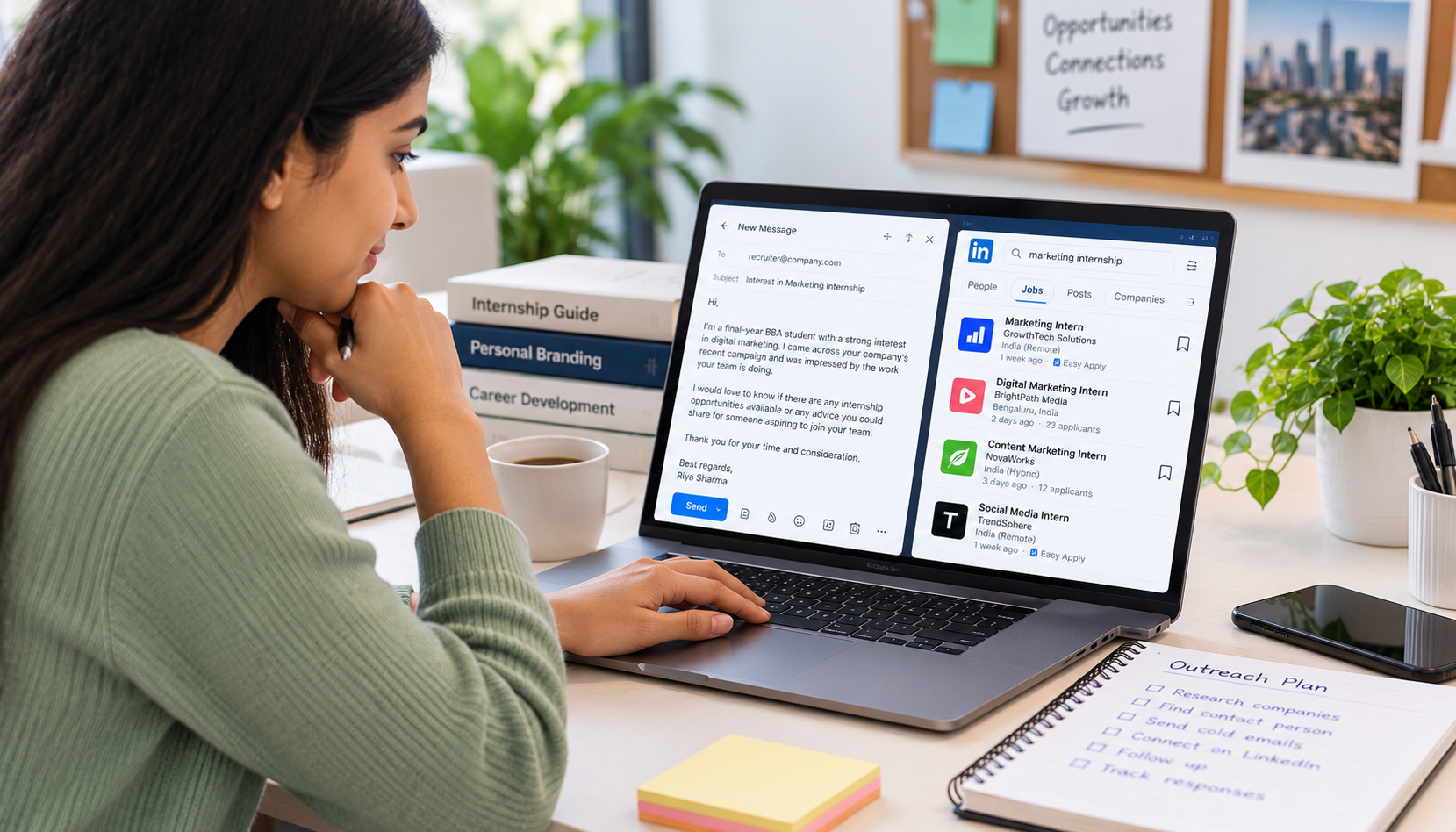
Looking for internships, entry-level jobs, or professional connections? Learn how to use cold emailing and LinkedIn outreach to introduce yourself, connect with recruiters, and discover career opportunities. This guide includes ready-to-customize email templates, LinkedIn message examples, follow-up strategies, and practical networking tips for students and freshers.
Introduction
Finding an internship or your first job can be challenging, particularly when you have limited professional experience. Applying through job portals and campus placement drives is useful, but these are not the only ways to discover opportunities.
Cold emailing and LinkedIn outreach allow students to introduce themselves to recruiters, hiring managers, alumni, and professionals working in their target industries.
However, sending more messages does not automatically lead to better results. A successful outreach strategy starts with researching the right people, writing relevant messages, demonstrating genuine interest, and making a clear, reasonable request.
In this guide, you will learn how to write professional cold emails, create effective LinkedIn messages, follow up respectfully, and use practical templates for internship and job opportunities.
What Is Cold Emailing and LinkedIn Outreach?
Cold emailing means contacting someone by email when you have not previously communicated with them. The recipient might be a recruiter, hiring manager, company founder, or professional in your preferred field.
LinkedIn outreach involves using connection requests, direct messages, and professional interactions to start relevant conversations.
Students can use these methods to:
- Discover internship and entry-level job opportunities.
- Connect with alumni and industry professionals.
- Learn about technical skills and career requirements.
- Ask thoughtful questions about a particular industry.
- Build professional relationships over time.
Outreach is not a guarantee of employment. Its purpose is to help you start relevant conversations and learn about opportunities that align with your skills and interests.
Why Cold Emailing and LinkedIn Outreach Matter for Students
Job portals and campus recruitment are valuable, but they may not cover every employer or opportunity. Professional networking gives students another way to learn about companies, understand job requirements, and connect with people in their chosen fields.
For example, a computer science student interested in software engineering could contact an alumnus working at a technology company to ask which technical skills are useful for internship applicants. A student interested in marketing could reach out to a professional to learn about entry-level responsibilities.
The goal is to establish a genuine professional connection, not to demand a referral or job from someone who does not know you.
1. How to Find the Right Person for Outreach
Effective outreach begins with identifying someone whose role is relevant to your goal. Depending on the situation, this might be a recruiter, hiring manager, team member, alumnus, or startup founder.
Research Before Sending Your Message
- Review the person's current role and professional background.
- Check the company's official careers page for available positions.
- Identify a genuine reason for contacting the recipient.
- Understand the skills required for your target role.
- Choose an appropriate communication channel.
For a software engineering internship, a recruiter responsible for early-career hiring or a professional working on the relevant team may be a suitable contact. Avoid messaging unrelated employees simply because they work at your target company.
Pro tip: Start with a manageable number of relevant, personalized messages instead of sending the same generic message to hundreds of people.
2. How to Write an Effective Cold Email
A good cold email respects the recipient's time. It explains who you are, why you are contacting them, and what you are asking for. Keep it concise, professional, and easy to understand.
Write a Clear Subject Line
Your subject line should communicate the purpose of the email without misleading claims or exaggerated promises.
- Inquiry About Software Engineering Internships
- Computer Science Student Interested in Your Team's Work
- Career Advice Request from a [College Name] Student
- Application for [Role Name] at [Company Name]
Personalize the Opening
Mention a relevant project, professional achievement, shared educational background, or aspect of the recipient's work that genuinely interests you. Do not invent a connection or pretend to know someone.
Introduce Yourself Briefly
State your name, degree or current role, relevant skills, and reason for reaching out. Include only details that support your purpose.
Make One Specific Request
Ask whether the team accepts interns, where to apply for a listed role, or whether the recipient would be open to a brief career conversation. Avoid making several unrelated requests at once.
End With a Professional Sign-Off
Thank the recipient for their time and include your name and a relevant LinkedIn, portfolio, or GitHub link when appropriate.
As a starting guideline, aim for approximately 100–180 words in an initial cold email. The appropriate length depends on the recipient and the purpose of the message.
3. Cold Email Templates for Students
The following cold email templates can be adapted for different situations. Replace the placeholders with accurate information and remove any claims that do not apply to you.
Template 1: Cold Email for an Internship
Subject: Interest in [Role] Internship at [Company Name]
Hi [Recipient Name],
My name is [Your Name], and I am a [Year] student pursuing [Degree] at [College Name]. I am interested in [Field] and have been developing my skills in [Relevant Skills].
I came across [Company Name] and was interested in your work on [Specific Product or Project]. I have also worked on [Relevant Project or Experience], which helped me develop my understanding of [Relevant Skill].
I wanted to ask whether your team expects to have internship opportunities in [Field]. I would be happy to share my resume or portfolio if useful.
Thank you for your time.
Best regards,
[Your Name]
[LinkedIn Profile] | [Portfolio or GitHub]
Template 2: Cold Email to a Recruiter
Subject: Inquiry About Entry-Level Opportunities in [Field]
Hi [Recruiter Name],
I am [Your Name], a [Degree or Graduation Year] student at [College Name], interested in entry-level opportunities in [Field or Role].
My current skills include [Relevant Skills], which I have applied in [Project, Internship, or Practical Experience]. I am interested in [Company Name] because of [Specific Reason].
Could you please let me know whether there are suitable internship or entry-level openings, or direct me to the appropriate careers page?
Thank you for your consideration.
Best regards,
[Your Name]
[LinkedIn Profile] | [Portfolio]
Template 3: Cold Email to a College Alumnus
Subject: Fellow [College Name] Student Seeking Career Advice
Hi [Alumnus Name],
I noticed that you studied at [College Name] and are now working as a [Role] at [Company Name].
I am currently a [Year] student exploring a career in [Field]. I would appreciate learning about your transition from college to your current role, particularly the skills that helped you get started.
If your schedule permits, would you be open to a brief 10–15-minute conversation? I completely understand if you are busy.
Thank you for your time.
Best regards,
[Your Name]
Template 4: Cold Email to a Startup Founder
Subject: Student Interested in Contributing to [Startup Name]
Hi [Founder Name],
I am [Your Name], a [Degree or Year] student interested in [Relevant Field].
I came across [Startup Name] and was particularly interested in [Specific Product or Problem]. I have experience with [Relevant Skills or Project] and would like to apply those skills to practical challenges.
I wanted to ask whether you might be open to considering students for internships or project-based opportunities in [Area].
My portfolio is available here: [Portfolio URL]
Thank you for considering my message.
Best regards,
[Your Name]
4. LinkedIn Outreach Templates for Students
LinkedIn messages should generally be shorter than emails. Introduce yourself, explain the connection, and make one reasonable request without overwhelming the recipient.
Template 1: LinkedIn Connection Request
Hi [Name], I am a [Year] student at [College Name] interested in [Field]. I came across your profile while exploring careers in [Industry] and would be glad to connect and learn from your professional journey.
Template 2: LinkedIn Message to a Recruiter
Hi [Name], I am a [Degree or Year] student interested in [Role or Field]. I have been developing my skills in [Relevant Skills] through [Project or Experience]. Could you point me toward suitable internship opportunities at [Company Name]? Thank you!
Template 3: LinkedIn Message to an Alumnus
Hi [Name], I noticed that we are both connected to [College Name]. I am exploring opportunities in [Field] and would appreciate hearing about your experience moving from college into your current role. Thanks for considering my request.
Template 4: Message to a Professional in Your Target Role
Hi [Name], I am learning about careers in [Field] and noticed your experience with [Relevant Area]. I am currently working on [Project or Skill] and would value any advice you might have for a student preparing for similar roles.
Template 5: LinkedIn Message After Applying for a Job
Hi [Name], I recently applied for the [Role Name] position at [Company Name]. My experience with [Relevant Skill or Project] aligns with aspects of the role, and I am excited about the opportunity. I wanted to introduce myself and ask if any additional information would be helpful. Thank you for your time.
Use the last template only if you have genuinely submitted an application. Keep your claims accurate and do not imply that the recipient is responsible for your application unless you know that to be the case.
5. Follow-Up Email and LinkedIn Templates
Not receiving a response does not necessarily mean someone is uninterested. They may be busy, have limited time, or have no suitable opportunities at the moment.
Follow-Up Email Template
Subject: Re: [Original Subject]
Hi [Recipient Name],
I wanted to follow up on my earlier message regarding [Specific Topic or Opportunity].
I understand you may have a busy schedule, so no worries if you are unable to respond. If there is a suitable person or resource I should contact instead, I would appreciate your guidance.
Thank you again for your time.
Best regards,
[Your Name]
LinkedIn Follow-Up Template
Hi [Name], I wanted to briefly follow up on my earlier message about [Topic]. I understand you may be busy, so no pressure to respond. Thank you for your time.
When Should You Follow Up?
- Wait approximately 5–7 business days before one polite follow-up.
- Follow the employer's stated recruitment timeline when available.
- If there is no response after your follow-up, generally move on.
- Respect requests not to be contacted.
- Avoid duplicate messages across several channels in quick succession.
6. Common Cold Emailing and LinkedIn Outreach Mistakes
Sending the Same Message to Everyone
Generic messages do not explain why a particular recipient is relevant. Personalize your opening and explain the genuine reason for contacting the person.
Asking for a Referral Immediately
Requesting a referral from a stranger can put unnecessary pressure on them. Start with a relevant question or professional connection, and discuss referrals only when appropriate.
Writing Long, Unfocused Messages
Recipients may not have time to read your entire academic history. Focus on your purpose, one or two relevant qualifications, and one clear request.
Making Unsupported Claims
Exaggerating your skills or inventing experience can damage trust. Describe your abilities honestly and provide evidence through real projects, coursework, or a portfolio.
Sending Too Many Follow-Ups
Repeatedly contacting someone who has not responded can appear intrusive. Send one reasonable follow-up and respect the recipient's time.
7. How to Improve Your Outreach Results
No message template guarantees a reply. Results depend on the relevance of the recipient, the quality of your message, the opportunity, and the recipient's availability.
Personalize Your Message
Mention one specific reason the person's role, company, or professional experience is relevant to your goal.
Show Evidence of Your Skills
Include a relevant project, portfolio, GitHub repository, or practical accomplishment when it supports your request. Avoid sharing unnecessary attachments or irrelevant links.
Make the Next Step Easy
Ask a question that can be answered briefly. An inquiry about the correct application page may be more reasonable than immediately requesting a lengthy meeting.
Track Your Outreach Efforts
Maintain a spreadsheet with the contact name, company, date, communication channel, purpose, and response status. This helps you follow up appropriately and avoid duplicate messages.
If your relevant messages consistently receive no replies, review your targeting, opening lines, and requests instead of simply sending more messages.
8. A Four-Week Outreach Action Plan for Students
Week 1: Prepare Your Professional Profile
Update your LinkedIn headline, education, skills, projects, and contact information. Prepare a concise resume and verify that your portfolio and GitHub links work.
Week 2: Identify Relevant Contacts
Create a shortlist of alumni, recruiters, professionals, and companies aligned with your interests. Research each contact and identify a genuine reason to reach out.
Week 3: Start Personalized Conversations
Send a manageable number of relevant emails and connection requests. Customize each message rather than copying the same template to everyone.
Week 4: Follow Up and Improve
Review responses, send appropriate follow-ups, and refine your approach based on what you learn. Continue applying through official recruitment channels alongside your outreach.
Outreach should complement your job search, not replace skill development, project work, and formal applications.
Cold Emailing vs. LinkedIn Outreach: Which Is Better?
Both channels can be useful. The right choice depends on your goal and the recipient's preferred communication method.
When to Use Cold Email
- You have a professional email address for the relevant person.
- You need to share a resume or portfolio.
- The employer provides an email address for recruitment inquiries.
When to Use LinkedIn
- You want to connect with alumni or industry professionals.
- You are looking for career insights or professional advice.
- You want to introduce yourself before a longer conversation.
Neither channel is inherently superior. Use the method most appropriate to the situation and avoid sending duplicate messages across several channels in quick succession.
How Guiding Academics Can Support Your Career Preparation
Building professional connections is one part of career preparation. Students also need relevant skills, practical projects, a clear resume, and a consistent approach to internship and job applications.
Guiding Academics provides career guidance and placement preparation resources to help students develop their skills and explore professional opportunities.
Explore our resume builder, internship opportunities, job preparation resources, and career guidance articles to support your next steps.
Conclusion
Cold emailing and LinkedIn outreach can help students expand their professional networks, learn about industries, and discover internship and entry-level opportunities beyond traditional job portals.
The strongest approach is not to send as many messages as possible. Identify relevant people, personalize your introduction, demonstrate genuine interest, make a reasonable request, and follow up respectfully.
Combined with strong skills, meaningful projects, and consistent applications, thoughtful outreach can become a valuable part of your career preparation strategy.
Ready to take the next step in your career? Visit Guiding Academics for career guidance and placement preparation resources.