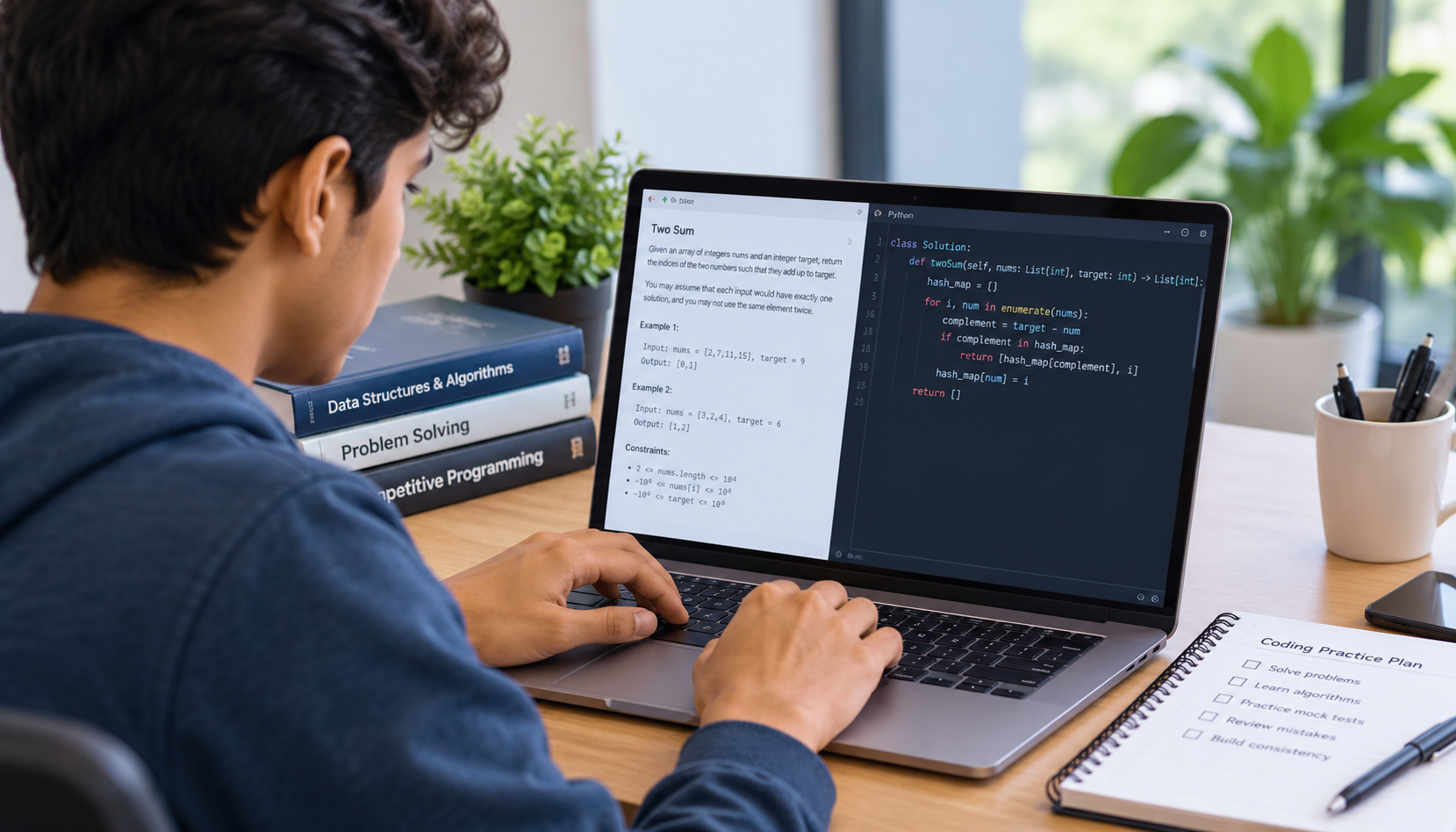
Coding assessments are an important part of technical hiring and campus placement processes. Learn the most common coding assessment mistakes, how to avoid them, and practical strategies to improve accuracy, problem-solving, and test performance.
Introduction
Coding assessments are commonly used to evaluate programming skills, logical reasoning, data structures, algorithms, and problem-solving ability. They are particularly important for students applying for internships, graduate roles, and software engineering positions.
However, understanding programming concepts does not always guarantee a good assessment score. Candidates can lose marks by misunderstanding problem statements, choosing inefficient algorithms, overlooking edge cases, or managing time poorly.
The good news is that many of these mistakes can be prevented. This guide explains 10 common coding assessment mistakes and shares practical coding assessment tips to help students and freshers prepare more effectively.
Why Are Coding Assessments Challenging?
Most coding assessments require candidates to solve one or more programming problems within a limited time. Depending on the platform and employer, candidates may also face multiple-choice questions, debugging exercises, or language-specific tasks.
A solution that works for a few sample inputs may fail hidden test cases. An algorithm that produces the correct result may also exceed the allowed execution time when the input becomes large.
Successful coding assessment preparation requires three core skills: understanding the problem, implementing a correct solution, and checking that the solution meets the stated constraints.
1. Misunderstanding the Problem Statement
One of the most common coding assessment mistakes is writing code before understanding the problem completely. Missing a constraint or misunderstanding the expected output can lead to an incorrect solution, even when the code is syntactically valid.
How to Avoid This Mistake
- Read the complete problem statement before coding.
- Identify the input format, expected output, and constraints.
- Work through the sample test cases manually.
- Explain the problem in your own words.
- Check whether duplicate values or special conditions matter.
Example: Finding the second-largest distinct element is different from finding the second element after sorting an array. Overlooking the word "distinct" can change the correct solution.
Tip: Spend a little time understanding the problem before choosing an algorithm.
2. Choosing an Inefficient Algorithm
A solution can be logically correct and still fail because it takes too long to execute. This often happens when candidates select an algorithm without considering input size or time complexity.
For example, comparing every pair of elements in an array using nested loops can take O(n²) time. A hash-based approach may solve certain related problems in average O(n) time, using additional memory.

How to Avoid This Mistake
- Understand common time complexities such as O(n), O(n log n), and O(n²).
- Check input constraints before choosing an approach.
- Look for repeated calculations that can be avoided.
- Practice sorting, binary search, hash maps, and two-pointer techniques.
- Consider the memory trade-offs of alternative solutions.
The best algorithm is one that meets the problem's correctness, performance, and memory requirements.
3. Ignoring Edge Cases
Passing sample test cases does not guarantee that a coding solution is correct. Hidden tests may include unusual but valid inputs that expose overlooked assumptions.
Important Cases to Test
- Empty inputs, if permitted by the problem.
- Arrays containing only one element.
- Duplicate values and negative numbers.
- Zero values and boundary conditions.
- Already sorted or reverse-sorted arrays.
- Minimum and maximum permitted input sizes.
- Cases where no valid answer exists.
Example: Initializing a maximum-value variable to zero can produce an incorrect result if all array elements are negative. When the input is guaranteed to be non-empty, initializing the variable from the first element is generally safer.
Tip: Before submitting, ask yourself which valid input is most likely to break your assumptions.
4. Poor Time Management During Coding Assessments
Spending too much time on one difficult question can leave insufficient time for easier problems. In assessments with multiple questions, this can reduce your overall score.
How to Manage Your Time
- Review the available questions before choosing where to start.
- Consider solving easier questions first when the format allows it.
- Set a tentative time limit for each problem.
- Move on when you are stuck for too long.
- Reserve time for testing and final submissions.
For a 60-minute assessment with three questions, one possible plan is to allocate 15 minutes to the first question, 20 minutes to the second, 15 minutes to the third, and 10 minutes for review. Adjust this plan according to the difficulty and scoring system.
Effective time management means balancing problem difficulty, available marks, and the time required to produce a reliable solution.
5. Writing Code Without Testing It
Submitting code immediately after writing it is risky. Small implementation errors can cause compilation failures, incorrect results, or unexpected behavior.
How to Avoid This Mistake
- Compile your code early when the platform permits.
- Run the provided sample inputs.
- Create additional tests for boundary conditions.
- Check loop boundaries and variable initialization.
- Verify the required output format.
- Investigate failing test cases instead of changing code randomly.
Testing is an essential part of problem-solving. A few targeted tests can reveal errors that are difficult to notice by reading code alone.
6. Overcomplicating the Solution
Some candidates use unnecessarily complex logic when a simpler approach would solve the problem. This increases debugging time and creates more opportunities for mistakes.
How to Avoid This Mistake
- Start with the simplest correct approach.
- Break complicated problems into smaller steps.
- Use meaningful variable and function names.
- Avoid unnecessary abstractions during timed assessments.
- Optimize when required by the constraints.
Simplicity should not come at the cost of performance. Aim for code that is easy to understand, correct, and efficient enough for the problem.
7. Neglecting Programming Fundamentals
Advanced algorithms cannot compensate for weak programming fundamentals. Errors involving loops, arrays, strings, recursion, data types, and input handling can affect even straightforward coding problems.
How to Strengthen Your Fundamentals
- Practice conditional statements, loops, functions, arrays, and strings.
- Learn the core data structures supported by your chosen language.
- Understand integer ranges, type conversions, and overflow risks.
- Practice reading input and producing the required output.
- Learn to interpret compiler errors and runtime exceptions.
Students preparing for campus placements should build a strong foundation before focusing exclusively on advanced algorithms.
8. Practicing Without Reviewing Mistakes
Solving a large number of coding problems does not automatically guarantee improvement. Repeated mistakes can continue if you do not understand why your previous solutions failed.
How to Make Practice More Effective
- Record the problem and the approach you attempted.
- Identify why your solution failed or performed poorly.
- Study a more suitable algorithm when necessary.
- Record the concept you need to revise.
- Revisit difficult problems after a few days.
A simple coding practice log helps you identify recurring weaknesses and focus your preparation on the areas that need improvement.
9. Ignoring Coding Platform Instructions
Different assessment platforms may require different submission formats. Some provide a function signature, while others expect a complete program that reads input and prints output.
How to Avoid Submission Errors
- Read the instructions before starting the assessment.
- Use the required programming language and version.
- Follow the expected function signature.
- Avoid unnecessary debugging output.
- Check time limits, memory limits, and library restrictions.
- Confirm whether the platform expects a returned value or printed output.
Always adapt your solution to the assessment environment rather than assuming every platform uses the same rules.
10. Neglecting Mock Coding Assessments
Practicing individual problems is useful, but it does not fully prepare you for the pressure of a timed coding assessment. Mock tests help you practice switching between problems, estimating difficulty, and working within a deadline.
How to Practice Effectively
- Take timed mock assessments regularly.
- Simulate the actual test environment where possible.
- Practice solving multiple problems in one session.
- Review incorrect answers after each test.
- Gradually increase the difficulty of your practice.
Consistent mock assessments can help students identify weaknesses before internship recruitment tests and campus placements.
Coding Assessment Checklist Before Submitting
Use this checklist to reduce avoidable mistakes during coding tests.
- I understand the problem statement and its constraints.
- My algorithm is appropriate for the expected input size.
- I have considered relevant edge cases.
- My code follows the required submission format.
- I have tested sample inputs and additional cases.
- I have checked for boundary errors and incorrect assumptions.
- My output matches the required format.
- I have reviewed my solution before submitting.
How Guiding Academics Can Help With Placement Preparation
Preparing for coding assessments requires more than memorizing syntax. Students need to develop problem-solving skills, understand data structures and algorithms, and practice applying their knowledge under time pressure.
Guiding Academics provides career guidance and placement preparation resources to help students develop their skills and explore internship and job opportunities.
Explore our job preparation resources, internship opportunities, and career guidance articles to support your career preparation.
Conclusion
Coding assessments can be challenging, but many common mistakes are preventable. Understanding the problem, choosing efficient algorithms, testing edge cases, managing time, and reviewing previous mistakes can improve your problem-solving process.
Successful preparation is not simply about writing code quickly. It is about producing correct, efficient, and reliable solutions within the available time.
Start with the fundamentals, practice consistently, and treat every assessment as an opportunity to improve.
Ready to improve your coding skills? Explore Guiding Academics for career guidance and placement preparation resources.